The Angkor Wat forest is usually full of sound—cicadas buzzing, leaves rustling, distant calls echoing through the tall trees. That morning felt different. The air was still, and even the birds seemed to pause.
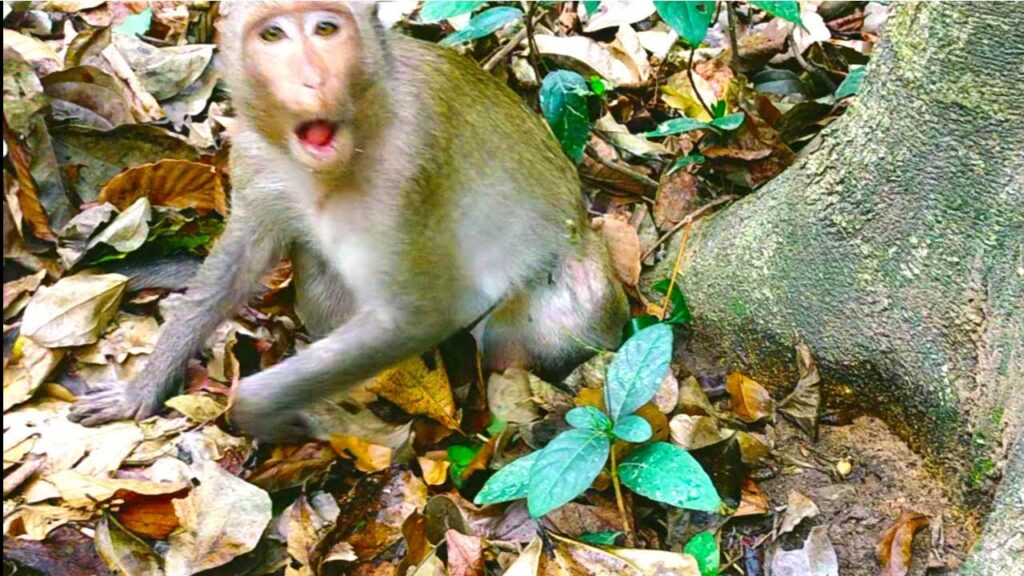
A young monkey clung to a narrow branch just above eye level. He wasn’t crying or moving. He simply held on, his small fingers wrapped tightly around the bark, his body stiff as if listening for something only he could sense.
From where I stood, it was clear he was alone. His mother was nowhere nearby, and the troop had moved deeper into the forest. For a young monkey, being left behind isn’t always dramatic—but it is always unsettling. He shifted his weight once, then stopped again, scanning the ground below.
Something had caught his attention. A movement in the undergrowth. Not a predator exactly, but unfamiliar enough to make him hesitate. In the wild, hesitation can feel heavy. You could see it in the way his chest rose and fell faster than before.
He let out a sharp call—not loud, not frantic—just enough to say, I’m here. The sound echoed briefly and disappeared into the trees. No answer came back.
For a long moment, nothing happened. Then, from farther down the path, another monkey appeared. An older female. She didn’t rush. She didn’t panic. She simply looked up at him and paused, as if measuring the distance, the risk, and the moment itself.
The young monkey watched her closely. His grip loosened just a little.
She climbed halfway, stopped again, and made a soft sound. Not a command—more like reassurance. Slowly, carefully, the forest seemed to breathe again. Leaves shifted. Light filtered through the canopy.
The young monkey moved at last, inch by inch, until he was close enough to feel safe. When he reached her, he pressed into her side without looking back.
Nothing dramatic followed. No chase. No danger revealed. Just a quiet reminder of how vulnerable young life can be—and how steady presence can change everything.
Some moments don’t need noise to be powerful. In the Angkor Wat forest, silence often says the most.