The forest near Angkor Wat was calm that morning, the kind of stillness that makes even the smallest movements feel important. Jane sat low to the ground, her body relaxed but alert, watching her young daughter, Jonna, shift her weight forward with the unsteady confidence of someone not quite ready to walk alone.
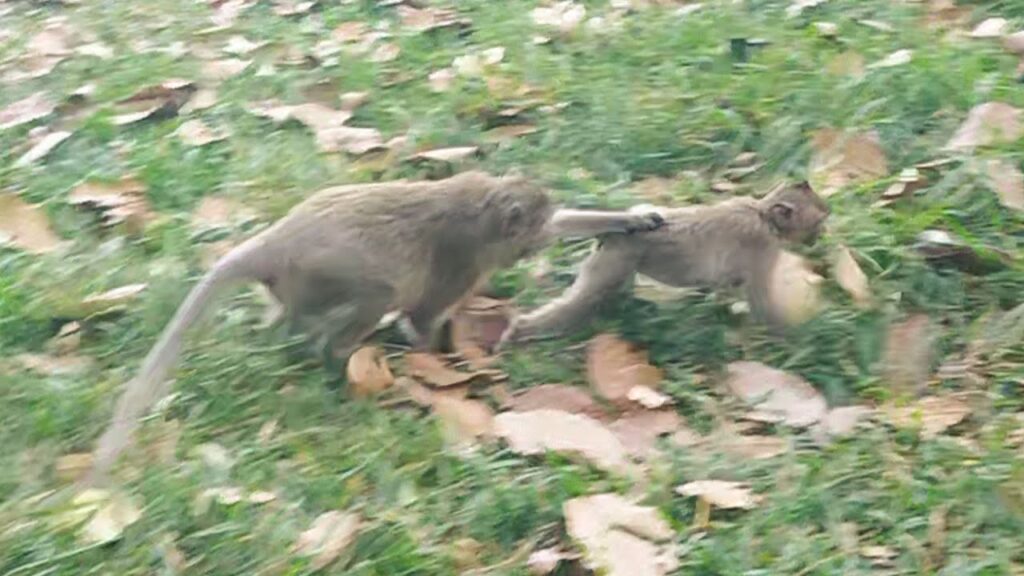
Jonna had been trying all morning—leaning, pausing, waiting. Each attempt ended the same way: a wobble, a pause, and a glance back at her mother. Jane allowed these moments, her eyes following closely, saying nothing. In the wild, silence often carries more meaning than sound.
Then it happened quickly.
Jonna lunged forward again, this time with more energy than balance. Before her feet could fully find the ground, Jane moved. It wasn’t panic—it was precision. One swift jump, and Jane gently but firmly caught Jonna mid-motion, guiding her down to the forest floor.
There was no anger in Jane’s face, only clarity. She placed Jonna in front of her, holding her still for a moment. The lesson wasn’t loud. It wasn’t dramatic. It was simply a pause.
Jonna protested softly, confused by the sudden stop. She wanted to move. She wanted to try again. But Jane stayed grounded, her presence steady, her body forming a quiet boundary. In that brief stillness, something passed between them—an understanding that some steps must wait.
This wasn’t punishment. It was protection.
Jane loosened her hold after a few seconds, allowing Jonna to sit and breathe. The young monkey looked around, then back at her mother. The urge to move had softened. The forest resumed its rhythm.
In moments like this, motherhood in the wild reveals itself not through constant comfort, but through timing. Jane didn’t stop Jonna from growing—she slowed her just enough to keep her safe.
As sunlight filtered through the leaves, Jonna remained close to the ground, watching, learning. Her steps would come. Jane knew that. And until then, she would be there—not to push, not to rush—but to guide.