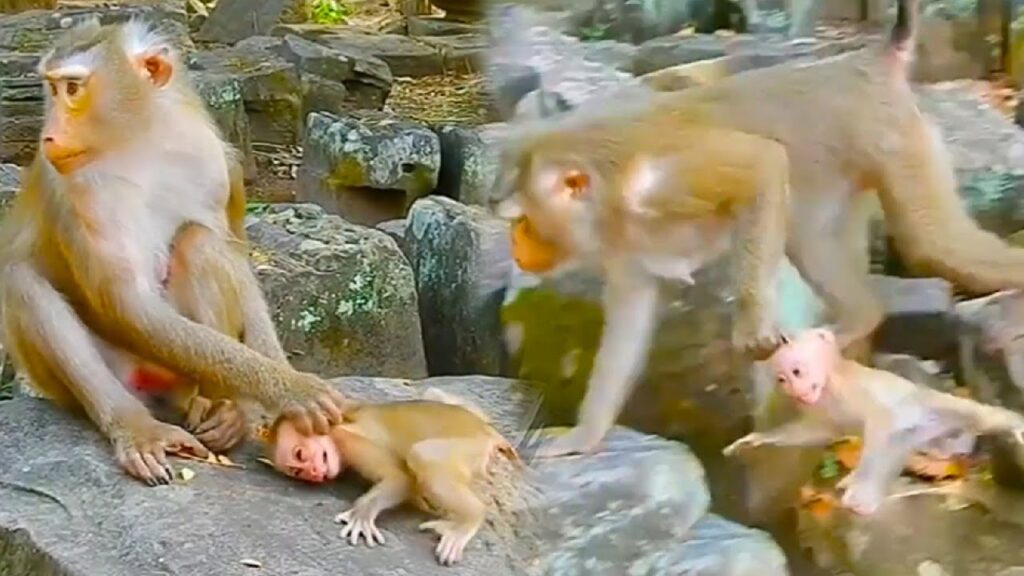
The morning air was cool and still, the kind of calm that settles gently over the forest just after sunrise. I had been watching quietly from a distance when the mother monkey pulled her baby closer. At first, it looked like an ordinary moment—protective, instinctive, familiar to anyone who has ever seen a mother gather her child.
Then something changed.
The baby squirmed, curious and unaware, reaching toward fallen leaves and light filtering through the branches. The mother’s grip tightened. Her hand moved to the baby’s head—not roughly, but firmly. The baby let out a small sound, not of fear, but confusion. It was not cruelty. It was tension.
In the wild, motherhood carries a weight that’s easy for humans to misunderstand. This mother wasn’t angry. She was overwhelmed. Her eyes scanned the forest constantly—other monkeys nearby, shifting hierarchies, invisible threats. Every movement mattered. Every sound could mean danger.
She pulled the baby closer again, holding the head still, as if saying without words: Stay. Be quiet. Be safe.
The baby resisted briefly, then softened. Its tiny body relaxed against her chest. The moment passed as quickly as it came, leaving behind a silence that felt heavy with meaning.
Watching this unfold reminded me how different love can look when survival is part of every decision. In the forest, there is no room for distraction. A mother’s actions are shaped by experience, by loss remembered, by instincts honed through generations.
As the sun rose higher, the mother loosened her grip. She groomed the baby gently, brushing away bits of leaf and dust. The earlier tension faded, replaced by calm closeness. The baby nuzzled in, trusting completely.
This wasn’t an act of harm. It was a moment of raw, imperfect care—love shaped by a world that does not pause.
Some lessons in nature are quiet. They ask us not to judge too quickly, but to look longer, and feel deeper.