The forest around Angkor Wat was unusually quiet that morning. Sunlight filtered gently through ancient trees, touching moss-covered stones that had stood for centuries. In that stillness, one sound broke through—a small, trembling cry.
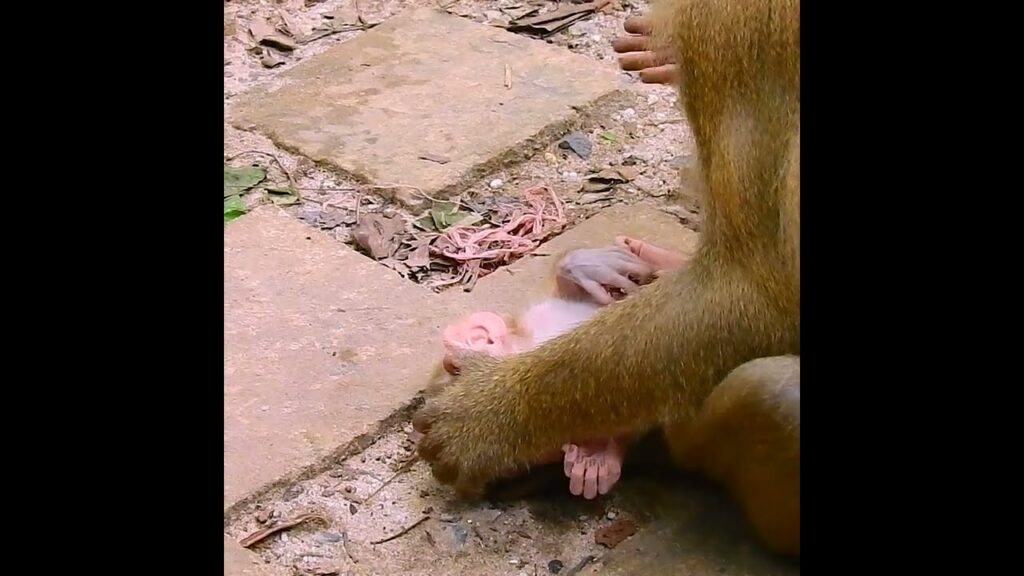
Luna, a baby monkey no bigger than a bundle of leaves, clung to a low branch. Her tiny chest rose and fell quickly as her voice called out again and again. Just moments earlier, her mother had been close—close enough for Luna to feel safe, close enough to believe the world was steady.
Then the tension began.
A brief conflict between adult monkeys shifted the balance of the group. There was movement, sharp glances, and sudden distance. Luna’s mother stepped away, drawn into the motion of the troop. She didn’t look back—not because she didn’t care, but because survival in the forest often demands choices made in seconds.
Luna didn’t understand any of that.
She cried louder now, her small body shaking with each call. The sound wasn’t dramatic or exaggerated—it was raw and honest. Anyone who has ever watched a child lose sight of a parent would recognize it immediately. It was the sound of confusion, not fear. Of waiting, not knowing how long.
The forest did not rush to comfort her. Leaves moved softly. Birds continued their routines. Life went on, indifferent but not cruel.
From a distance, Luna’s mother paused. She watched. Her body remained still, alert. This was not abandonment—it was instinct wrestling with care. In the wild, teaching independence often begins earlier than feels comfortable to witness.
Minutes passed. Luna’s cries softened, then returned, then softened again. She shifted her grip, learning the branch beneath her hands. Between cries, she breathed. Between breaths, she waited.
And slowly, something changed.
Her calls became less frantic. Her posture steadied. The forest, unchanged, held her anyway.
Moments like this are easy to misunderstand. They can look harsh when viewed briefly, without context. But staying long enough—long enough to see the pause, the watching eyes, the return—reveals something quieter and deeper.
Luna was not forgotten. She was learning.
And in the ancient forest, surrounded by stone and roots older than memory, her small voice mattered.