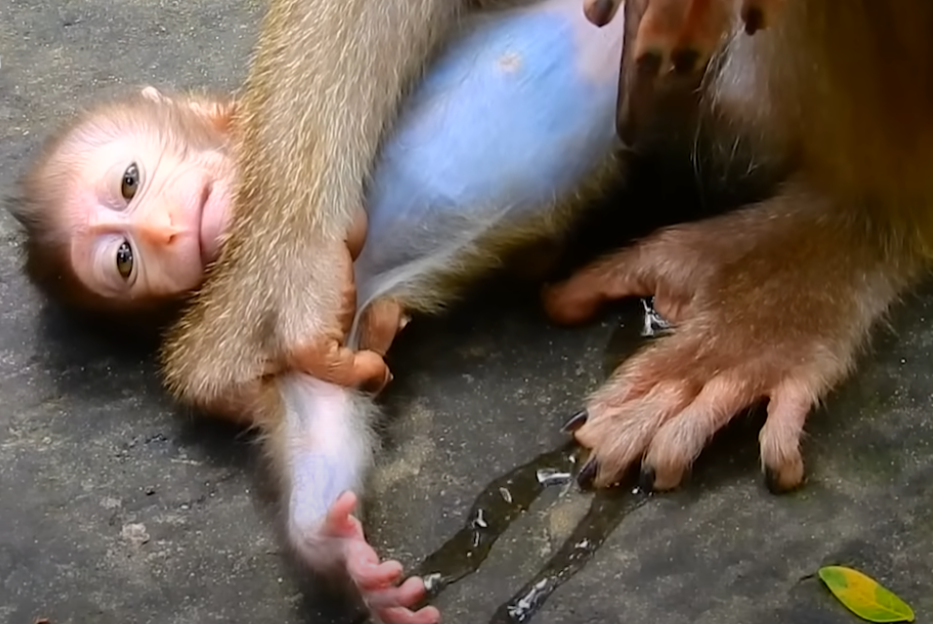
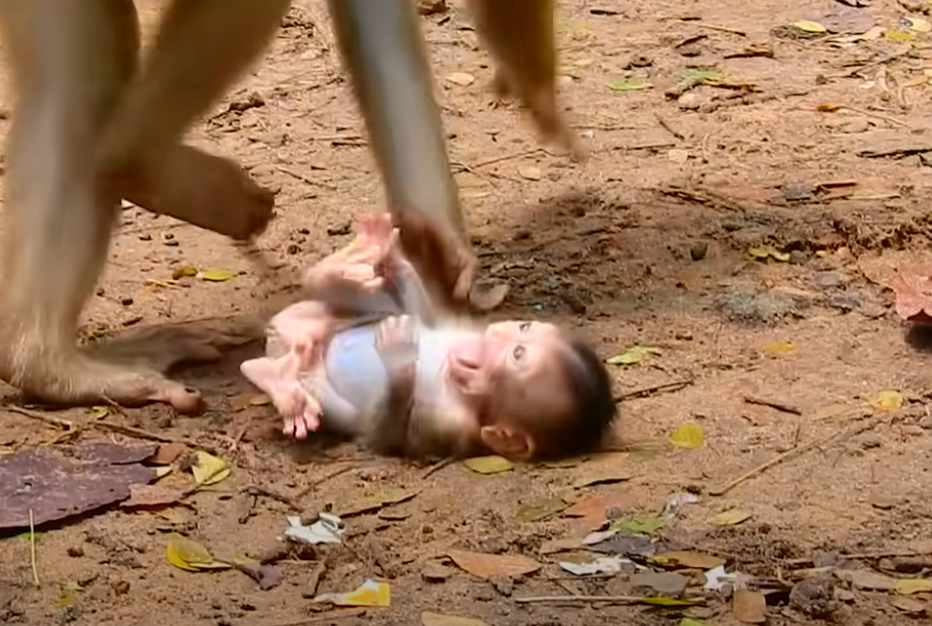
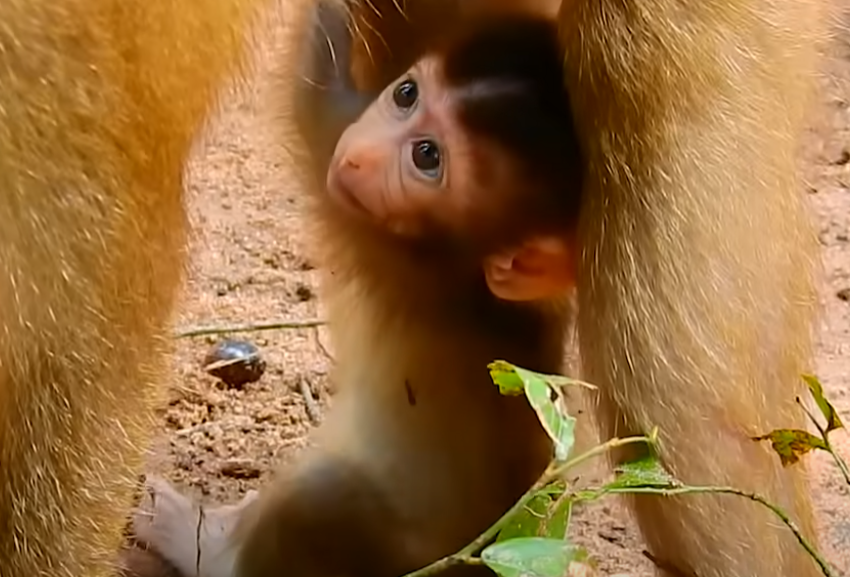
It was just after sunrise in Angkor Wat, and a damp mist clung to the forest floor. I remember the stillness, the kind that presses against your chest. That’s when I saw her—tiny Rainbow, alone, shivering on a patch of wet earth beneath the tall strangler fig tree.
She was hunched over, arms wrapped around her little body, trying to preserve what little warmth she had left. Her belly was hollow, her energy drained. The other babies were snuggled against their mothers, feeding, playing, safe. But Rainbow had no such comfort.
Her mother had disappeared weeks ago. Taken, perhaps by a predator or separated during the chaos of a territorial fight. Since then, Rainbow had tried to find safety with Libby, the dominant female and de facto stepmother. But Libby had no room in her heart.
I watched from just a few meters away as Rainbow made another attempt. With staggering steps, she approached Libby, her eyes glassy but hopeful. She reached out—not demanding, just pleading—and let out the tiniest squeak, the kind that only babies make when they’re too tired to cry.
Libby glanced back.
And then she turned away.
No milk. No embrace. Just indifference.
It wasn’t even anger. That would have meant Rainbow mattered. This was worse. She was invisible.
Rainbow slumped back down. Her head drooped, and she rested her chin on the cold ground. I zoomed in with my camera and captured her soft shivering. Her fur was matted from the dew. Her ribs, faintly visible now, rose and fell with each breath. It was more than neglect—it was survival being denied.
The forest carried on, as if nothing was wrong. Libby began grooming her own biological baby with care, pulling gently at tiny tufts of hair, cleaning her ears. Rainbow watched, and I swear I saw a tear form in her eye. Maybe it was dew. Maybe not.
For over an hour, Rainbow barely moved. I almost stepped in. But human interference in a wild troop can do more harm than good. So I waited.
And then came a change.
Another female, younger and lower in the troop hierarchy—a monkey named Mera—noticed Rainbow. Mera had no baby of her own, but she had curiosity and a kind heart. She crept over slowly and sat nearby.
At first, she didn’t touch Rainbow. She simply shared space.
And in that moment, Rainbow looked up.
Their eyes met. There was no fear, only wonder. Mera slowly extended a hand and brushed a leaf from Rainbow’s fur. Rainbow didn’t flinch. She leaned in.
That was the beginning.
Mera didn’t feed Rainbow, but she let her curl beside her, using her body heat to warm the baby. She didn’t groom her completely, but she touched her gently, enough to say: you’re not alone.
The next morning, I returned. Rainbow was still alive. Still weak, but now she had a companion. I watched her follow Mera a few steps, her gait still wobbly but purposeful.
She had hope.
Not every monkey will accept another’s baby. Nature can be harsh, and dominance means survival. But what I witnessed was something far deeper than instinct. It was mercy. It was kindness.
And it saved Rainbow.
Even now, weeks later, Rainbow clings to Mera at times. She still watches Libby from afar, as if wondering why she wasn’t good enough. But she no longer begs. She no longer shivers alone in the dirt.
Because someone saw her.
And sometimes, that’s all it takes to change a life.