The morning sun had barely risen over the ancient stones of Angkor Wat when the forest stirred with whispers—not from the wind, but from something far more sacred. News spread like wildfire among caretakers, forest wanderers, and even among the monkeys themselves: Luna had given birth. Again.
But this time… it was different.
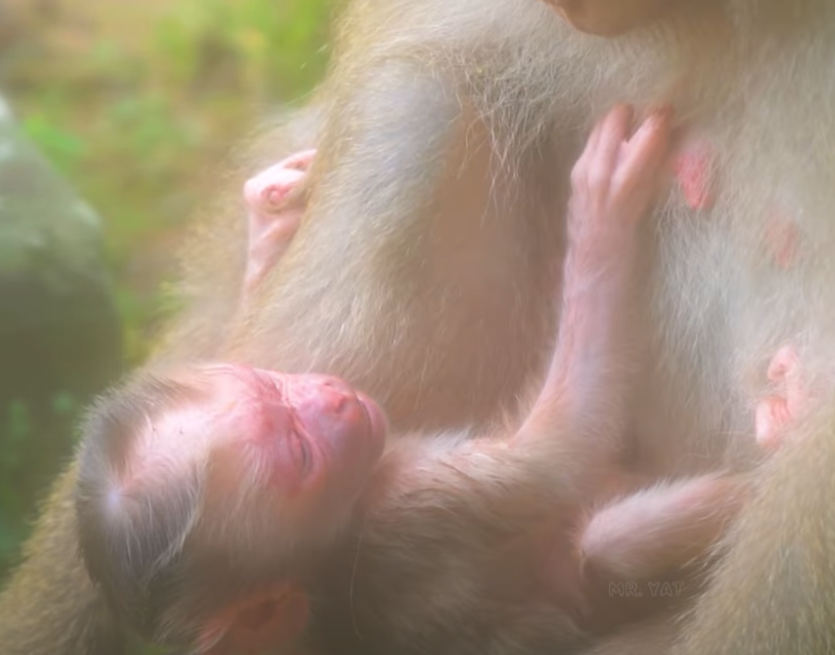
It was July 28, 2025. A date I will never forget.
I had just finished my quiet morning tea near the edge of the forest when a soft, hurried voice came through the radio: “Luna’s in labor—near the banyan roots!”
My heart jumped. Luna, the intelligent, fiercely maternal macaque we had come to adore, was about to bring new life into the world—for the third time. Her first child was a bold little male, now playful and strong. Her second baby was sadly lost too young. And now… here she was, trusting this same wild world again, her belly round with promise, her breath slow but focused.
By the time I arrived, Luna had found shade under a cluster of twisted vines near the temple walls—her sanctuary. Other females lingered at a distance, silently supporting her. It was just past 8 AM when I saw the tiniest limb stretch into the light.
Tears welled up in my eyes.
A baby girl.
A beautiful, healthy baby girl.
Tiny fingers wrapped around her mama’s fur. Her eyes—still blurry from the birth—sought warmth and comfort, and Luna gave it in full. She drew the baby close, wrapping her tail gently around her like a promise: “You’re safe now.”
I had seen monkey births before, but never one like this.
Luna’s face showed something that hit me hard—relief, exhaustion, and unconditional love. She nuzzled her baby, inspecting every inch with that careful mother’s instinct. And even as other monkeys tiptoed in curiosity, Luna kept her focus firm. She was glowing with protectiveness.
As the hours passed, Luna’s troop grew more curious. Little ones approached first, their heads tilted, reaching cautiously. Then came her eldest son, a little hesitant but drawn by the sound of new life. When he finally peeked under Luna’s arm and saw his baby sister, he didn’t push or play. He just sat beside her, touching her foot as if saying, “I’ll protect you too.”
The moment was sacred.
We named her Lyla, a soft name for a bright soul.
That afternoon, the forest seemed more alive. Birds sang louder. The leaves shimmered as if clapping in joy. Even the breeze that blew through the Angkor ruins felt like a blessing.
Watching Luna cradle her newborn under the old Angkor trees reminded me why these stories matter—not just to those of us here, but to everyone, everywhere.
Because motherhood isn’t just a human experience.
It’s universal.
It’s sacred.
And in a world where so much feels broken, moments like this remind us that hope still blooms—even under weathered roots and ancient skies.
Luna’s journey is one of survival, love, and resilience. Three babies. One tragic loss. And still, she believes in life.
Still, she gives her heart fully.
As the day faded into twilight, Luna climbed a small ledge with baby Lyla nestled at her chest. She looked out over the forest as if introducing her daughter to the world she would one day explore.
And then she did something I’ll never forget.
She looked at me.
For just a moment—eyes meeting, two mothers acknowledging each other across species.
I smiled, whispering through tears, “She’s beautiful, Luna. You did it.”