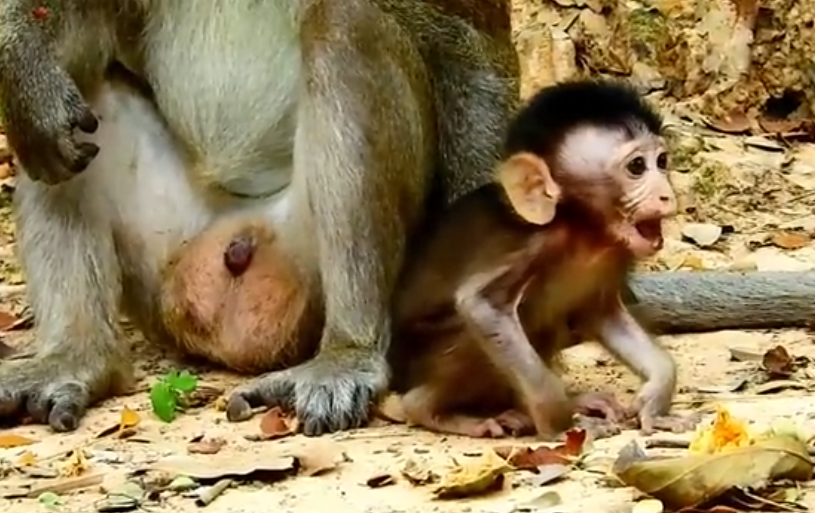
In the heart of a dense green forest, just past the bend of the river where the banyan trees stretch high into the sky, a little baby monkey named Milo was born under a soft sunrise. His father, a strong and respected male named Maku, was there the day Milo first opened his tiny eyes. Milo’s world began with the sound of his father’s heartbeat and the warmth of his father’s arms.
From his earliest days, Milo followed Papa everywhere. He clung to Maku’s back, giggled when Papa flipped through trees, and squealed with joy every time Papa fed him a piece of fruit. They were always together—until one day, they weren’t.
Maku had recently taken a new mate. A younger female in the troop had given birth, and the hierarchy within their monkey family began to shift. In the wild, things can change quickly. Affection turns into avoidance. Priorities shift. Bonds that once seemed unbreakable start to crack.
It started with the small things—Maku grooming the new baby instead of Milo. Then came the silence. No more soft grunts or tail tugs of encouragement. And finally, the unthinkable: Papa looked right at Milo… and walked away.
Milo didn’t understand. His tiny hands trembled as he ran after his father. The troop was on the move, and Milo’s steps were clumsy, his legs still unsteady. He stumbled over a root and let out a tiny whimper. Still, he ran. He caught up and tugged gently at Maku’s leg. And in the saddest voice a baby could make, he squeaked:
“Please, Papa… I am your son…”
But Maku did not turn around.
He didn’t acknowledge the baby who once slept curled against his chest. He just pulled his leg away and walked on with the rest of the group. To the others, it may have looked normal—just another baby learning independence—but to Milo, it felt like his whole world cracked open.
The other females in the troop were busy with their own young. No one had time for the rejected one. He sat alone on a patch of cold dirt, his little body hunched, chest quietly heaving in broken sobs. His eyes didn’t leave the troop. He kept hoping, maybe—just maybe—Papa would look back.
But Maku never did.
Hours passed. The sun shifted across the sky. Milo hadn’t moved much. His tail barely twitched. Then, a miracle: a low-ranking female named Rani, who had lost her own baby weeks before, noticed the still figure near the trees. She crept toward Milo slowly, offering a piece of overripe fruit.
Milo didn’t move at first. But when she gently brushed his back and let out a soft purr, he looked up, and for a moment, accepted the kindness. She licked the dirt from his fur, groomed his tiny arms, and let him lean into her warmth.
It wasn’t Papa. But it was something.
From that day on, Rani became his protector, his shadow. She wasn’t as strong, and she couldn’t carry him far. But she made sure he ate. She comforted him when thunder cracked the sky. And she never, ever walked away without looking back.
Still, every now and then, Milo would see Maku from a distance. The way his tail curled, the sound of his warning bark… it always made Milo’s heart jump. But he didn’t chase anymore. He just watched. Silently. Painfully.
Because no matter how many days passed, he still remembered that moment in the dust—his tiny fingers clinging to a leg that no longer welcomed him, whispering the words every child deserves to have heard:
“Please, Papa… I am your son.”